Mushroom Mooring Anchor for Small Craft and Buoys | Cast Iron or Cast Steel, 50–500 kg
Product Overview
The mushroom mooring anchor is a bell-shaped seabed anchor intended mainly for soft mud or silt, where its broad dished head can settle and progressively embed under repeated horizontal mooring loads. It is commonly selected for small craft, navigation buoys, marker buoys, beacon boats, light floating structures, and other protected-water mooring arrangements that require a compact permanent or semi-permanent anchor.
The supplied dimensional series covers nominal anchor weights from 50 to 500 kg and may be produced in cast iron, cast steel, or stainless steel according to the confirmed project specification. Selection should consider the intended service, seabed condition, vessel or buoy displacement, water depth, current, wind and wave exposure, mooring chain geometry, shackle compatibility, corrosion protection, handling method, and required inspection scope. A permanent mooring anchor should not be selected from boat length or anchor weight alone.
Anchor Type & Suitable Conditions
Mushroom anchors develop their best holding behavior when the bell can seat and bury in soft cohesive sediment and the mooring line applies a predominantly low-angle horizontal pull. They are not a universal solution for rock, coral, dense hard clay, coarse gravel, or locations where the bell cannot penetrate or remain correctly oriented. For exposed moorings, public navigation aids, or safety-critical service, the complete anchor, chain, swivel, shackle, riser, buoy and pennant arrangement should be engineered and approved as one mooring system.
Quick Specifications
- Product type: Mushroom mooring anchor → broad bell-shaped seabed anchor for soft-bottom permanent or semi-permanent moorings.
- Main dimensional series: 50 / 100 / 150 / 250 / 350 / 500 kg → commercial-size range for small craft, buoy and light floating-structure projects.
- Separate small-craft guide: M25 to M500 in pounds → supplier-provided reference series that must not be mixed directly with the 50–500 kg dimension table.
- Material options: Cast iron, cast steel or stainless steel → final grade, casting specification and corrosion allowance to be confirmed before production.
- Seabed suitability: Soft mud and silt preferred → holding performance depends on burial, bottom consistency and a low-angle mooring pull.
- Connection arrangement: Integral upper eye → eye opening, shackle size, chain grade and swivel arrangement should be checked together.
- Surface protection: Hot-dip galvanizing, black bituminous coating, marine paint system, or polished stainless steel → coating selection depends on material and service environment.
- Documentation: Maker certificate, material records, dimensional report, coating report and class survey may be arranged → exact certificate and test scope must be agreed in the order.
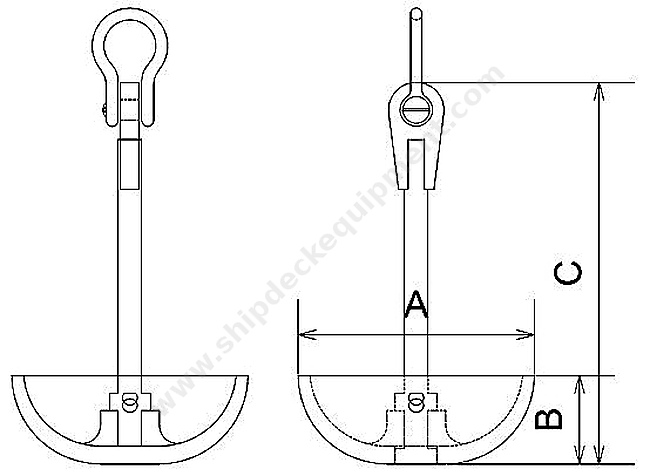
Main Technical Parameters
Weight
(lbs) |
A
(mm) |
B
(mm) |
C
(mm) |
| 50 |
Ø430 |
115 |
680 |
| 100 |
Ø550 |
180 |
802 |
| 150 |
Ø655 |
210 |
968 |
| 250 |
Ø730 |
245 |
988 |
| 350 |
Ø750 |
265 |
988 |
| 500 |
Ø750 |
330 |
988 |
| Anchor Model |
Weight
(lbs) |
Boat Size
(feet) |
|
| M25 |
25 |
Up to 10 |
|
| M50 |
50 |
10-14 |
|
| M75 |
75 |
14-16 |
|
| M100 |
100 |
16-18 |
|
| M150 |
150 |
18-20 |
|
| M200 |
200 |
20-24 |
|
| M250 |
250 |
25-29 |
|
| M300 |
300 |
30-32 |
|
| M400 |
400 |
35-37 |
|
| M500 |
500 |
37-39 |
|
Selection & Inquiry Guide
Step 1: Confirm the duty: permanent mooring, semi-permanent buoy mooring, temporary small-craft anchoring, or secondary / drag-anchor use.
Step 2: Provide vessel, buoy or floating-structure details, including displacement or buoyancy, principal dimensions, windage, service area and required holding function.
Step 3: Confirm seabed type, water depth, tidal range, current, wind and wave exposure, and whether local authority or harbor-master mooring rules apply.
Step 4: Confirm the required series and unit: 50–500 kg dimensional anchor or M25–M500 pound-based small-craft model; do not mix the two ranges.
Step 5: Confirm material, anchor weight, eye opening, chain size and grade, shackle / swivel arrangement, corrosion allowance and handling method.
Step 6: Confirm surface treatment and inspection scope, including coating system, galvanizing requirement, material certificate, dimensional report, NDT, proof-load test or class survey if required.
Step 7: Provide quantity, delivery destination, required delivery time, project drawing, mooring arrangement and real reference photo if available.
Structure
Bell-shaped anchor body | Broad seabed contact area | Central shank | Integral connection eye | Rounded casting transitions | Optional model-specific drainage / relief holes | Protective coating or polished stainless finish
Holding Principle & Mooring Integration
Anchor is lowered with the bell correctly oriented toward the seabed → Bell seats on soft mud or silt → Repeated low-angle mooring loads encourage progressive burial and suction resistance → Chain catenary helps keep the load direction low → Eye, shackle, swivel and chain transfer the mooring force into the anchor → Position, burial and component condition are checked during installation and periodic inspection
Casting, Connection & Corrosion Protection
- The broad bell geometry provides a large contact area for soft sediment; the edge profile, wall thickness and shank transition should follow the approved drawing rather than an assumed generic shape.
- The integral eye is a mooring connection point. Eye diameter and clear opening should be matched with the selected shackle pin, chain end link and swivel without side loading or restricted articulation.
- Cast iron offers economical mass and is commonly used for permanent mushroom moorings, while cast steel may be selected where improved toughness, repairability or project-specific inspection is required. Exact grades are to be confirmed.
- Casting quality control should cover chemical / mechanical properties when specified, visual inspection, weight and dimensional checks, eye and shank integrity, and model-specific NDT according to the agreed inspection plan.
- Hot-dip galvanizing suitability, zinc thickness and surface preparation should be confirmed for the selected casting grade. Black bituminous paint or a marine coating system may be more appropriate for some commercial mooring anchors.
- Polished finishing applies mainly to stainless steel. PVC, PE or vinyl coating is typically associated with smaller small-craft products and should not be assumed for the complete 50–500 kg commercial series without process confirmation.
- No holding capacity, proof load or safe working load is declared by the supplied tables. Any required holding-load basis or test load must be defined by the mooring design and accepted test procedure.
Custom Attributes
- Product Category: Mushroom mooring anchor → seabed anchoring component for soft-bottom small-craft and buoy moorings.
- Service Mode: Permanent / semi-permanent mooring or selected temporary small-craft use → duty must be confirmed before sizing.
- Main Weight Range: 50–500 kg → based on the supplied commercial dimensional series.
- Small-Craft Reference Range: M25–M500, 25–500 lb → separate supplier reference family requiring model confirmation.
- Material: Cast iron / cast steel / stainless steel → exact grade and casting specification to be confirmed.
- Connection: Integral eye for shackle and chain → eye dimensions and compatible hardware must be confirmed by drawing.
- Surface Treatment: Hot-dip galvanized / black bitumen / marine paint / polished stainless / customized → selected according to material and immersion service.
- Certification Scope: According to project requirement → maker, material, inspection and class documents are not assumed unless included in the order.
Applications
Small craft permanent moorings | Navigation and marker buoys | Beacon boats | Protected harbor moorings | Lake and river moorings | Light floating pontoons | Secondary anchors for suitable small craft | Soft-mud and silt seabeds
Certifications & Documentation
Inspection and documentation can be arranged according to the confirmed material, anchor design, test plan, project specification and class approval procedure. Class certificates are not supplied automatically and remain subject to design acceptance, survey availability and the agreed order scope.
Certification: CCS, NK, BV, ABS, DNV, LR, KR, IRS, RS, RINA, CRS, Makers Test Certificate — available according to project requirement and subject to class approval.
Drawing & Photos
FAQ
Q1: Which seabed conditions are suitable for a mushroom anchor?
A1: Soft mud and silt are the preferred conditions because the bell can seat and progressively bury. Rock, coral, hard clay and coarse gravel may prevent proper setting. A seabed assessment is recommended for permanent or exposed moorings.
Q2: Can the anchor be selected only by boat length?
A2: No. Boat length is only a rough reference for some small retail models. Permanent mooring selection should consider displacement, windage, environmental loads, water depth, chain catenary, seabed strength, scope and local mooring rules.
Q3: What is the difference between cast iron and cast steel mushroom anchors?
A3: Cast iron provides economical weight and is widely used for conventional permanent moorings. Cast steel may be preferred where greater toughness, repairability, material traceability or project-specific testing is required. The final material grade, eye design, coating and inspection scope should be confirmed before quotation.
Product Tags:

|
|
Mushroom Mooring Anchor for Small Craft and Buoys | Cast Iron or Cast Steel, 50–500 kg Images
|


